






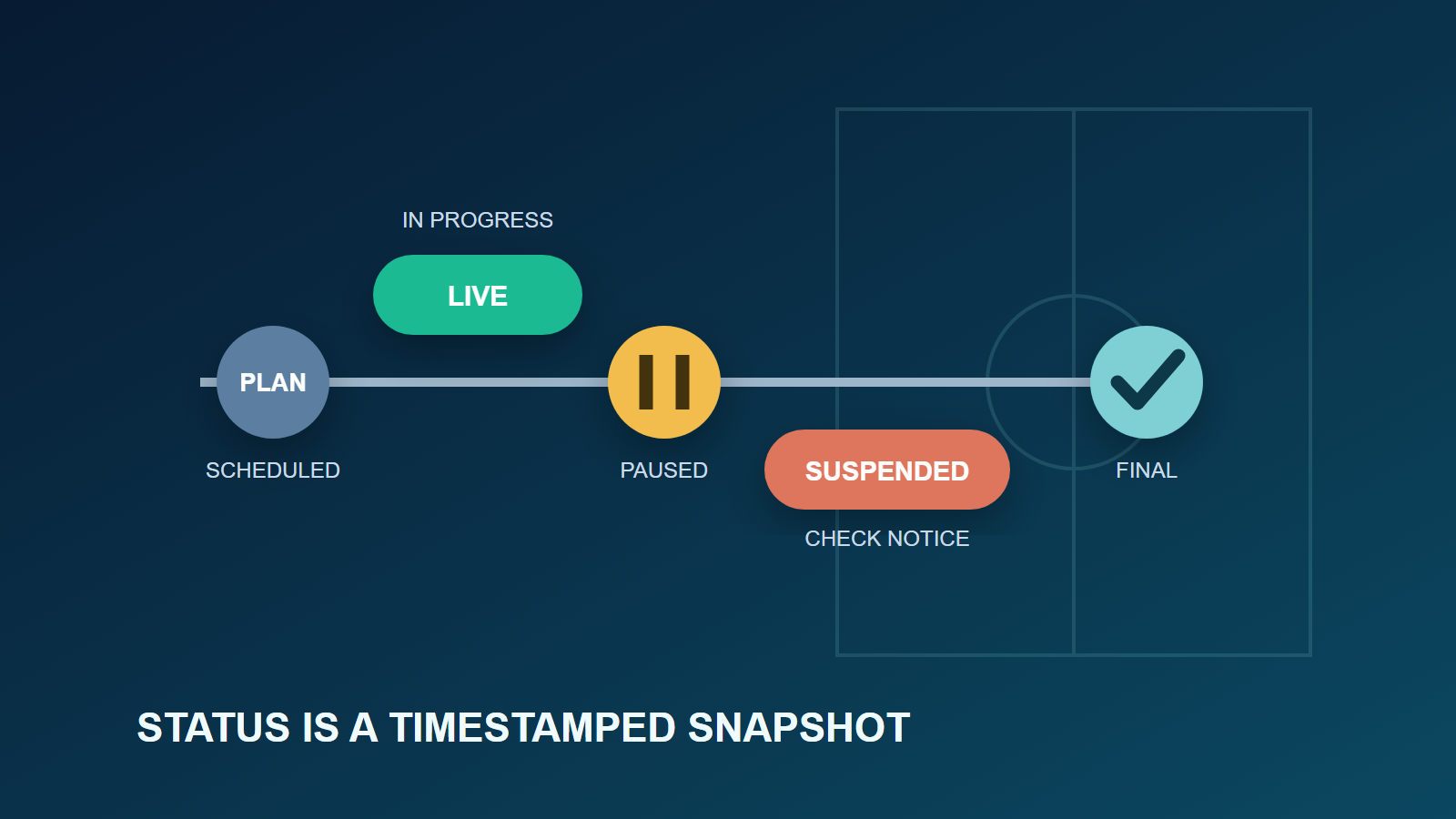
Scheduled, Live, Suspended or Final: How to Read Match Status Labels
Understand common match status labels, why feeds can update at different times, and which source to check before treating a result as final.
About This Article
This article is part of the Wabo Entertainment blog, where readers can learn about online gaming topics, platform updates, and category-specific guides. Use the links below to continue to FAQ, Terms, or related game pages.
A fixture can appear as scheduled on one screen, live on another and suspended on a third. The difference may come from update timing, feed rules or the source’s definition—not necessarily from a changed result. Match status labels are useful only when the source and timestamp are visible.
Scheduled and delayed are not the same
Scheduled normally means the event is listed for a future start time. A countdown reaching zero does not guarantee that play has begun. Teams may still be preparing, officials may delay the start, or the data feed may be waiting for confirmation.
Delayed usually means the planned start has passed or been moved, while the event is still expected to begin. Providers can use different wording, so readers should check the competition notice rather than infer a new time from the label alone.
Live is a feed state, not a promise of zero delay
A live label tells readers that the source treats the match as in progress. Scoreboards, television pictures and text commentary can update at different speeds. The visible clock may also pause during an interruption or represent elapsed playing time differently.
Use the page’s update timestamp when comparing sources. A one-minute difference between two displays is not meaningful unless both were captured at the same moment and use the same data convention.
Suspended, interrupted and abandoned
Suspended or interrupted generally indicates that play has stopped after starting and may resume. Abandoned generally indicates that the match will not continue under the current decision. The referee has authority under the IFAB Laws of the Game to stop, suspend or abandon a match, but competition rules determine what happens next.
Do not turn a feed label into a settlement conclusion. Whether an external service treats an interrupted event as valid, postponed or void depends on its published rules and the official competition decision.
Postponed and cancelled refer to scheduling
Postponed normally means the match will not start or resume at the planned time and may be rearranged. Cancelled may mean no replacement date is currently set. These labels do not establish a new fixture until the organiser publishes one.
When a replacement match is announced, check whether it keeps the same competition round, venue and fixture identifier. A new listing with the same teams can still be a separate record.
Finished, final and after penalties
Finished or final indicates that the source considers the event complete. The score should still be read with its context: full time, after extra time or after penalties. The IFAB Law 7 page explains match periods and allowance for time lost; competition formats determine whether extra time and penalties follow.
A five-point source check
- Record the exact fixture, competition and date.
- Capture the status label and its update time.
- Check the organiser or competition’s official notice.
- Distinguish the match result from any external settlement rule.
- Recheck later if the status is provisional.
For related terminology, see the site’s football odds and markets guide. The article on providers, operators and review sites also explains why the correct source depends on whether the question concerns a feed, an account or editorial commentary.
Commercial link disclosure
WABO222 is a customer-requested external commercial reference. It is not the authority for the match-status definitions above, and the link makes no claim about its operator, licensing, availability, data feed or safety.
Status labels are snapshots. The most reliable reading combines the label, timestamp, competition notice and applicable rules without assuming that every feed uses identical wording.