Scheduled, Live, Suspended or Final: How to Read Match Status Labels
Understand common match status labels, why feeds can update at different times, and which source to check before treating a result as final.








This article is part of the Wabo Entertainment blog, where readers can learn about online gaming topics, platform updates, and category-specific guides. Use the links below to continue to FAQ, Terms, or related game pages.
A live match timeline can update faster than the official match report. A goal may appear and then be removed, a card may be assigned to the wrong player, or a substitution may be listed before the player enters the field. Reading the timeline well means tracking event status, not just the first notification.
This guide explains the common fields and how to confirm them. It does not settle bets or replace the competition’s official record.
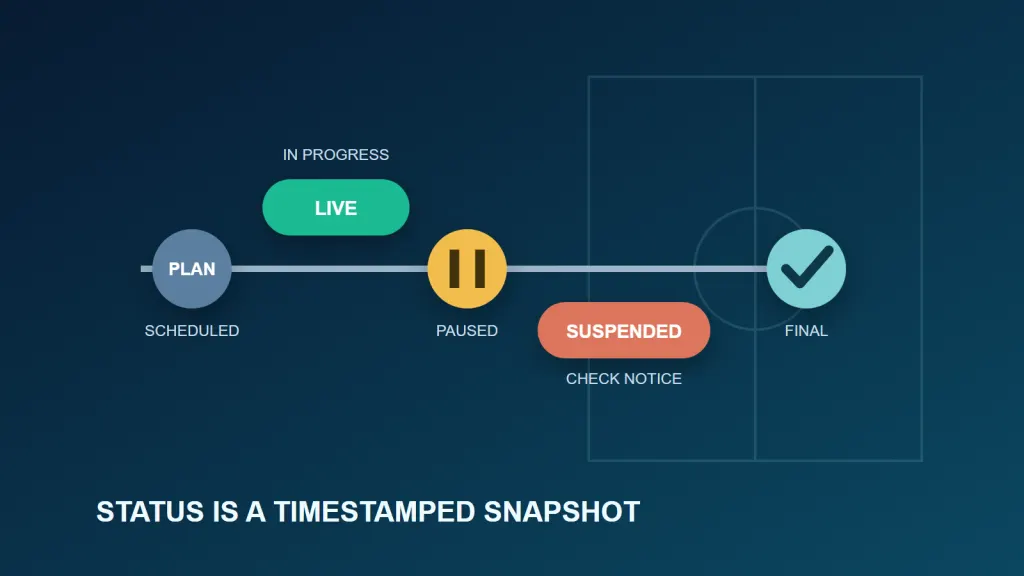
Before reading individual events, check whether the match is scheduled, live, suspended, postponed or final. A timeline from a suspended match can stop for reasons unrelated to the data feed. Use the match-status labels guide to understand the overall state first.
Also confirm the competition, teams, date and venue. Clubs with similar names or youth and women’s teams can appear in the same search results.
An event marked 45+3 happened during first-half stoppage time, not in the 48th minute of normal play. A second-half event may be corrected after the feed receives official data. Record the displayed minute and the update time separately if accuracy matters.
Do not use a single timestamp to infer the exact length of a delay. Broadcast feeds, data providers and official reports can publish at different times.
Some feeds add a goal immediately, then mark a VAR check or remove the goal if the referee changes the decision. IFAB’s VAR protocol limits review assistance to defined match-changing categories, including goal/no goal, penalty/no penalty, certain red-card situations and mistaken identity.
The referee makes the final decision. A “VAR” label alone does not mean the original decision changed. Wait for the restart and the official event status before treating the goal as confirmed.
A useful card record includes the player, team, minute and whether it was yellow, second yellow or direct red. Early feeds can assign a card to the wrong player and correct it later.
If the player leaves the field after a red card, check the confirmed lineup and substitution list before calculating the number of players remaining. Do not assume every red-card graphic refers to an on-field player; substitutes and team officials can also receive disciplinary sanctions.
A substitution should identify the player leaving and the player entering. The announcement time may differ from the moment play restarts. If a player was replaced before kickoff or never entered the field, the event may be recorded as a lineup change rather than an in-match substitution.
Use the pre-match squad and confirmed-lineup guide to establish the starting XI and substitutes before interpreting the live change.
For any disputed timeline, record:
| Field | What to save |
|---|---|
| Match identity | competition, teams, date |
| Event | goal, VAR, card or substitution |
| Displayed minute | including added-time notation |
| Initial status | shown, checking, cancelled or confirmed |
| Final source | competition or club match report |
| Checked time | date, time and timezone |
Preserve the original entry before refreshing. If the event changes, add a second row rather than overwriting the first. That creates a small audit trail without assuming why the first feed was wrong.
After the match, compare the timeline with the competition’s official report. A social post or screenshot can help explain what viewers saw, but it should not replace the final record. If two sources still disagree, label the event unconfirmed and note the difference.
Readers who want to continue from football information to the WABO platform should use the WABO official site. This is a commercial destination, not a source for the football rules or event data in this article.
A live event record describes what has been reported. It does not predict the next goal, guarantee a result or prove that one team will win. Treat the timeline as an information tool and keep any gambling decision within a fixed entertainment budget.
The most reliable reading order is simple: confirm match status, identify the event, note whether it is under review, wait for the referee’s final decision and verify the completed match against the official report.
Responsible play: Gambling involves financial risk. Set time and spending limits, never chase losses and stop if gambling affects your finances or wellbeing.